A few years ago, searching was simple.
You opened Google, typed in a keyword, and clicked on a few links.
You read some web pages and then decided which information was useful.
But now, something new is happening. AI has changed the way we search.
People are doing more than just searching. They’re using ChatGPT and Grok. They are getting answers from generative AI features.
They are using AI platforms to compare, explain, summarise and make decisions. This shift is real, and it means:
SEO is no longer just about achieving high rankings. It’s now about becoming the quick solution.
And this is where AI search optimisation can help.
In 2026, AI-driven search engines like Google’s AIO (AI Mode & AI Overviews), ChatGPT, and Bing Copilot are changing the rules of SEO.
Optimising for AI means more than just keywords; it’s about creating helpful, human-sounding content, structuring information for easy extraction, achieving technical excellence and establishing genuine authority.
This AI SEO checklist covers everything you need to future-proof your site, from content and search intent to technical details and AI-specific strategies.
You can use it as your AISEO roadmap for ranking in AI Overviews and answer engines.
Your 20 Free AI Search Optimization Checklist in 2026 by Suresh.tech
1. Content & AI Search Intent:
1.1 Writing for Humans and AI
Understand search intent for your target keyword.
AI search engines prioritize content that directly answers user queries.
Before writing, ask: What is the searcher really looking for?
Is it a quick answer, an in-depth guide, or a product recommendation?
Action steps to follow:
- Analyze SERPs for your target keywords.
- Analyze ChatGPT and Google’s AI overview for your topic.
- Use search features like People Also Ask to find related questions.
- Structure your content to address both primary and secondary search intents.
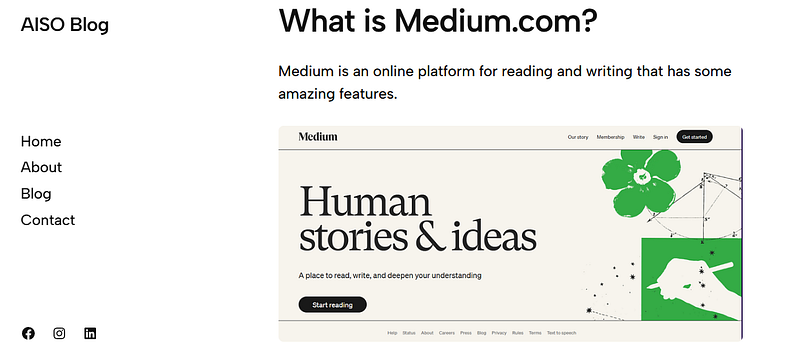
For example, this AISO Blog’s Medium.com guide, which is a helpful resource, will teach you everything you need to know about Medium blogging.
1.2 Write for People First, Not Just Algorithms
AI can detect robotic, keyword-stuffed writing. It’s not easy to trick AI.
Focus on clarity, empathy, and real expertise while creating content for your brand.
Action steps to follow:
- Use natural, conversational language.
- Share personal experiences, opinions, and unique insights.
- Use direct, helpful answers.
- Use short paragraphs that are easy to read and consume.
1.3 Provide Complete, Actionable Answers
AI Overviews pull “chunks” of content to answer questions.
Make every section of your post self-contained and actionable.
Action steps to follow:
- Use bullet points and numbered lists for steps or checklists.
- Summarize key points at the end of each section.
- Use tables, images, and infographics to show the visual content.
2. On-Page & Structure:
2.1 Optimizing for Chunk-Level Retrieval
Use clear titles, headings, and subheadings for your target page.
AI search engines use headings to understand your content’s structure and pull relevant snippets.
Action steps to follow:
- Use H2s for main sections, H3s for sub-points.
- Include keywords naturally in headings.
2.2 Keep Paragraphs Short and Scannable
Long blocks of text don’t work for AI or humans. Use short paragraphs (1–3 sentences) and simple language.
Action steps to follow:
- Break up complex ideas with lists and tables.
- Add bold or italics for emphasis.
- Add summary and key takeaways for your page.
2.3 Add Internal Links to Live, Relevant Posts
Internal links help AI understand your site’s structure and keep users engaged.
For example:
- For on-page tips, see: My Checklist for On-Page SEO Tasks in 2026
- For off-page strategies, check: My Checklist for Off-Page SEO Tasks in 2026
2.4 Optimize Metadata
Meta titles and descriptions help search engines and users understand your page.
Action steps to follow:
- Write unique, descriptive titles and meta descriptions for each page.
- Include a clear call-to-action in descriptions.
2.5 Use Schema Markup
Structured data helps AI extract and display your content in answer boxes and overviews.
- Add FAQ, HowTo, and Article schema where relevant.
- Use tools like Schema.org or Schema plugins for WordPress to implement markup.
3. Off-Page AI SEO:
3.1 Building Authority and Trust
Earn or build high-quality backlinks to rank in AI Search.
Backlinks from authoritative sites are still critical for AI SEO. They signal trust and expertise.
Action steps to follow:
- Focus on earning links from respected sources in your niche.
- Try guest posting, expert roundups, and collaborations.
- Learn more: What are Backlinks and How to Get Them.
Check out this helpful resource from Suresh.tech on building high-quality profile backlinks.
3.2 Build E-E-A-T (Experience, Expertise, Authoritativeness, Trustworthiness)
AI search engines use E-E-A-T signals to evaluate your content.
Showing your experience and authority matters the most.
Action steps to follow:
- Showcase credentials and real-world experience.
- Add author bios and cite sources.
- Reference your personal experiences.
3.3 Encourage Brand Mentions
Even unlinked brand mentions can count as trust signals for AI.
Action steps to follow:
- Monitor your brand across the web.
- Engage in social media and online communities.
- Show how your brand connects and helps.
- Show the human side of your brand.
For example, I’m Suresh Chaudhary. I’m an online marketer. I have over fifteen years’ experience working in online marketing to help brands across the globe achieve their business marketing goals. I manage two websites, AISO blog and Suresh.tech.
4. Technical SEO for AI:
4.1 Speed, Crawlability, and Accessibility
Optimize your website speed for higher search visibility in AI.
Fast-loading sites are favored by both AI and human users.
Action steps to follow:
- Compress images and use next-gen formats.
- Minimize JavaScript and CSS.
- Use a reliable host and CDN network.
4.2 Ensure Mobile-Friendliness
Most searches happen on mobile. Use responsive design and test on multiple devices.
Make your website URLs Clean and Descriptive.
Neat URLs help with crawling and user understanding.
Action steps to follow:
- Use hyphens, not underscores.
- Include target keywords.
- Keep URL length short and to the point.
4.3 Check Crawlability and Indexing
Make sure AI bots can access and understand your content.
Action steps to follow:
- Submit your sitemap to Google Search Console.
- Use tools to check AI crawlability, like 5 Free AI Crawl Checkers: Can AI Bots Read Your Page?
- Avoid unnecessary “noindex” tags and robots.txt blocks.
- Avoid LLM.txt and AI bot blocks.
4.4 Use Alt Text and Descriptive Media
AI “reads” images via alt text. Make your visuals accessible and informative.
Action steps to follow:
- Name your image with the relevant keyword.
- Add descriptive alt text to every image.
- Use the best file type and resize your image for speed.
5. AI Search Specifics:
5.1 Satisfying Google’s SGE and AI Overviews
Structure your content for AI overviews.
Google’s AI Overview, ChatGPT and similar AI-powered answer engines extract content at the “chunk” level.
Each heading, list, or answer should stand alone.
Action steps to follow:
- Use clear, focused sections.
- Start answers with a direct statement, then elaborate.
- Give examples, case studies, and use cases.
5.2 Include Q&A and FAQ Sections
FAQs make your content more likely to appear in AI answers and featured snippets.
Action steps to follow:
- Cover all the important questions related to your topic.
- Add a relevant FAQ section at the end of major posts.
- Use the FAQ schema tag for search engines.
5.3 Leverage AI Tools (But Stay Authentic)
You can use AI tools for research, outlines, and content drafts—but always add your unique voice.
The top four AI writing assistants offering a free plan are Koala AI, Rytr.me, Neuroflash, and Scalenut. All 4 offer an impressive free trial plan and a monthly word limit.
ContentBot, NeuronWriter, and Frase are best AI SEO writing generators, all offering a 7-day free trial. You can upgrade as your requirements.
Source: https://medium.com/@bedigisure/free-ai-content-generator-11ef7cbb2aa0
Action steps to follow:
- Edit AI-generated content for clarity and authenticity.
- Avoid publishing unedited machine text.
- Optimize content with my on-page SEO tips.
5.4 Monitor AI Search Results
Regularly check how your content appears in AI Overviews and answer engines.
Action steps to follow:
- Search for your target keywords and review AI summaries.
- Update content to improve extraction and accuracy.
5.5 Stay Updated on AI SEO Trends
AI search evolves rapidly. Follow industry leaders and experiment with new strategies.
- For the latest, see: Google AI Overviews: What They Are, How They Work and Tips to Optimise for AIO.
- Explore future trends: The Rise of AI-Powered Search: A Game Changer.
What is an AI Search Checklist?
The AI SEO Checklist is a free guide from the AISO blog. It focuses on creating helpful, human-sounding content and optimising it for a clear structure (headings, short paragraphs and Q&As).
It also covers ensuring technical excellence (speed, schema and crawlability) and building authority (E-E-A-T and backlinks).
This makes content easily extractable for AI Overviews and answer engines, such as ChatGPT and Google.
Key actions include understanding search intent, optimising metadata, structuring content for retrieval at the level of individual chunks, and using AI tools for content creation while maintaining authenticity.
How does it help your business?
Increased AI visibility and traffic: It ensures your content is found in AI-driven answer boxes as well as traditional search snippets, capturing the attention of users seeking direct answers.
Better user experience: It provides users with direct, synthesised answers from your site, improving satisfaction and trust.
Competitive advantage: It positions your brand as a credible source, outperforming competitors who haven’t adapted to AI search.
Deeper insights: AI can analyse competitor content gaps to reveal new topics to cover.
Don’t miss the basics: Foundation
Website Basics
- A clear brand description on the homepage that explains what you do in one or two sentences.
- A consistent brand name that is used across all pages with the same exact spelling and capitalisation.
- A clear statement of the company’s founding date and history.
- Your service or product pricing information easily understandable.
- Product/service descriptions that include specific features and benefits.
- A clearly defined target audience (“Solves X problem” or “designed for ABC”).
Structured Data
- Organisation schema with name, description, URL, logo, and founding date
- Product/software application schema for each product
- FAQ section on relevant pages
- Review/rating schema, if applicable
- Breadcrumb schema for navigation hierarchy
- Article schema on blog posts
Brand Info Consistency
- Google Business Page matches the website information
- LinkedIn company page has accurate, current information
- Zoominfo profile (if applicable) is up to date
- Social media profiles have consistent brand information
- Brand article (if notable enough) is accurate
Content Structure & Optimisation
Definitional content
- “What is [your brand]?” page with a clear explanation
- “How [your services] work” page with a detailed breakdown
- “[your brand] vs. alternatives” comparison page
- “Who uses [your services]?” page with use cases
- “[your service] pricing” page with clear tiers
Question-based content
- FAQ page covering common customer questions
- Individual FAQ items with actual questions as headers
- ‘How to’ guides for common tasks in your category
- Buying guides for your service category
- Entity explainer (e.g., ‘What is AEO?’)
Business use case content:
- Industry-specific pages (e.g., ‘Content tools for SEO‘)
- Company size pages (e.g., ‘AI tools for small businesses’)
- Role-specific pages (e.g., ‘AI tools for writers’)
- Problem-specific pages (e.g., ‘Platforms for managing backlinks‘)
Brand Authority Building
Online Media and Digital PR
- News page on your website with media coverage and business press releases
- At least 10 mentions in authoritative industry publications
- Leadership articles and news updates published
- Podcast appearances or interviews
- News coverage for major brand announcements
Review websites
- G2 business profile complete with current information (B2B)
- Capterra brand profile complete with current information (B2B)
- Trustpilot brand profile with customer reviews (B2C)
- Industry-specific review sites (e.g., AI Tools Directory for AI-powered ventures)
- 50+ reviews on primary review platforms
Third-party content & Guest posts
- Listed in ‘best of X’ roundup blog posts in your category
- Included in comparison list posts (vs. your competitors)
- Mentioned in online resources (e.g., podcasts, courses, tutorials)
- Cited in research or reports relevant to your industry
Technical Website Optimisation
Website performance
- Mobile-first design and experience
- Fast loading (under 2.5 seconds)
- Secure (HTTPS)
- Accessible (WCAG compliant)
- Accessible to AI agents
- No broken links or errors
Site crawlability
- Sitemap page on website
- XML sitemap submitted to Google Search Console
- Robots.txt allows important search and agentic crawlers (Such as Googlebot, Bingbot, ChatGPT-User, etc.)
- Clean URL structure (descriptive and hierarchical)
- Internal linking connects related web pages
- No orphan pages
Content formatting
- Clear heading structure (H1, H2, H3) on all web pages and articles
- Bullet points and lists for scannable content
- Tables for comparison
- Bold/emphasis on key terms and phrases
- Quotable paragraphs (clear, definitive sentences that AI can cite)
Final Checklist: 6 Action Steps for AI SEO Success
- Research search intent and write for people first.
- Structure content with clear headings, short paragraphs, and internal links.
- Build authority with backlinks, E-E-A-T, and brand mentions.
- Optimize technical SEO: speed, mobile, crawlability, and alt text.
- Format for AI search: FAQs, schema, and chunk-level answers.
- Monitor, update, and stay ahead of AI SEO trends.
Collection For Further Reading & Resources
- My Checklist for On-Page SEO Tasks in 2026
- My Checklist for Off-Page SEO Tasks in 2026
- I Followed Google’s Advice to Index My Website Aiso.blog
- How to start blogging for free?
- New Search Marketing Components – GEO, AEO, LLMO, SAO, AISO & More
By following this AI SEO checklist, you’ll not only rank higher in traditional search but also become more visible in AI Overviews, answer engines, and the future of search.
Suresh’s pro tip: Stay human and helpful, and keep adapting to the new world of AI-driven SEO.
About Suresh
