SEO stands for search engine optimization.
AISO stands for AI search optimization.
SEO is helpful for:
SEO improves the visibility of a website or webpage in search engine results pages (SERPs) by using keywords and backlinks.
For example,
This is my review post about FrogDr SEO tool, which is ranking at the top of Google.
Snapshot for your reference:
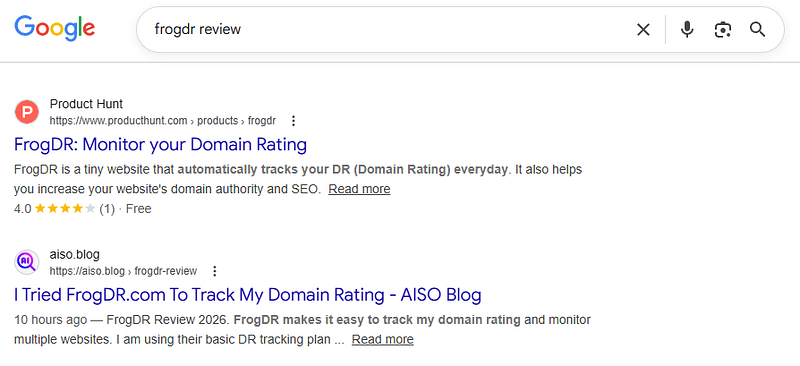
This is the power of Good SEO. This is the power of Suresh.tech.
AISO is helpful for:
AISO optimises content for AI-driven searches by focusing on clarity, context, and authority, and by providing direct answers to satisfy AI models such as ChatGPT and Google’s AI Overviews.
The aim is to ensure that content is accurately cited and retrieved in AI summaries rather than simply being clicked on via traditional links.
For example,
This is my review of AI SEO Tracker, cited by ChatGPT for the keyword ‘AISEOTracker Review‘.
Snapshot for your reference:
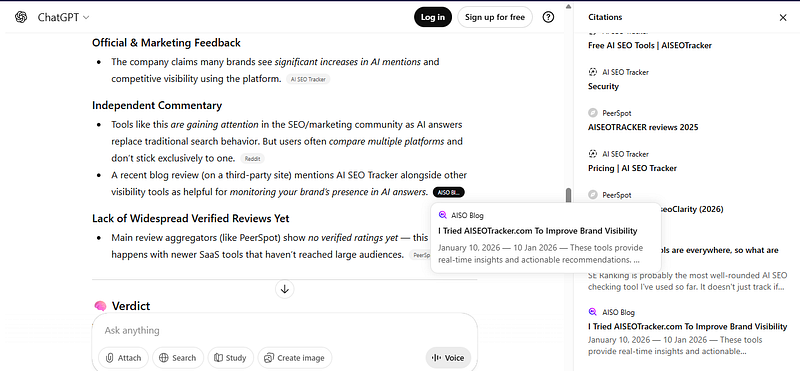
SEO vs. AISO Comparison
Here’s a clear comparison table that organizes SEO and AISO, with the current market trend:
| Features | SEO (Search Engine Optimization) | AISO (AI Search Optimization) |
|---|---|---|
| Goal | Rank high in SERPs for keyword queries to drive website traffic | Ensure content is retrieved and cited by AI models in conversational search |
| Focus | Keyword density, link building, technical SEO, and on-page optimization (titles, meta descriptions) | Semantic clarity, structured data, answerability, topical authority, user intent, E-E-A-T |
| Content Style | Long-form, in-depth articles with strong keyword integration | Clear, scannable formats that answer fragmented queries directly and build trust for AI citation |
| Metrics | Clicks, rankings, organic traffic | Inclusion in AI snippets, mentions, relevance in AI summaries, and user engagement signals |
| Objective | SEO for clicks | AISO for AI search citation |
| Target | Search algorithms and users | AI crawlers and LLMs |
| Evolution | Ranking documents in search results | Delivering direct, trusted answers for AI systems |
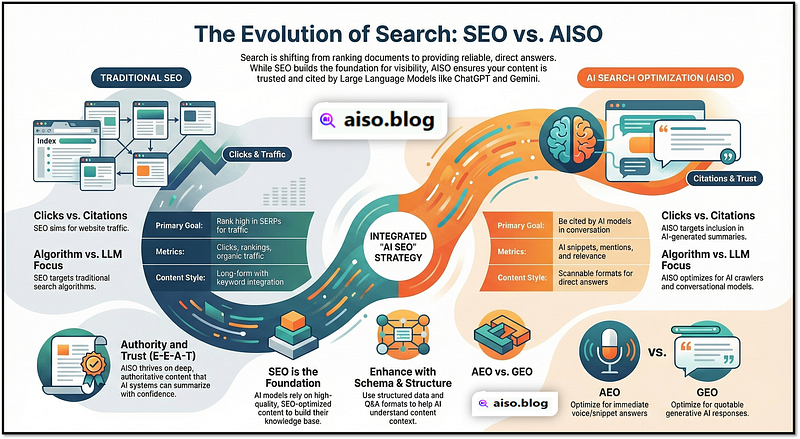
The Evolution of Search: SEO vs AISO
Find out more about the evolution of search with this infographic presentation from AISO.blog!
What is the difference between AISO and AEO?
Both AEO (Answer Engine Optimisation) and AISO (AI Search Optimisation) are advanced approaches that extend beyond traditional SEO.
However, they serve distinct purposes in the evolving search landscape.
AEO is helpful for:
AEO focuses on making content the direct answer to user queries. The aim is to achieve visibility in ‘Position Zero’, featured snippets, and voice assistants such as Siri and Alexa, as well as AI-generated summaries.
To this end, AEO uses conversational language, FAQ-style structures, and concise, bulleted responses to provide immediate clarity.
AEO is best suited to short-tail queries, voice search, and situations where users expect quick, direct answers.
AISO as compared to AEO
AISO is designed for AI-native search engines and conversational platforms, such as ChatGPT, Perplexity, and Gemini.
Its goal is to ensure that content is cited as a trusted source or becomes the authoritative answer within generative AI responses, not just to increase visibility.
AISO strategies emphasise topical authority, entity-based SEO, structured data, and building brand trust, enabling large language models to recognise and rely on the content.
Unlike AEO, which focuses on brevity, AISO thrives on deep, comprehensive, and authoritative content that AI systems can summarise with confidence.
Essentially, AEO involves optimising for immediate answers in human-facing search experiences, whereas AISO involves positioning content as a reliable foundation for AI-driven knowledge systems.
Together, they represent a shift in focus from ranking documents to providing reliable answers in both traditional and AI-powered search environments.
Is AISO better than SEO?
Let’s be clear: AISO isn’t replacing SEO, it’s adapting it.
AI itself is learning.
Businesses that use AISO to enhance their marketing strategies will have an advantage in terms of search visibility and audience engagement.
In simple terms, SEO aims to generate clicks, whereas AISO aims to ensure inclusion and establish trust within AI-generated answers like Google AI overviews, ChatGPT, and more.
AISO requires a deeper level of expertise, authority, and the creation of structured, scannable content.
Here is the free AI search checklist to help you boost your AI rankings and search visibility on the AISO Blog.
How they work together (the new AI SEO)
SEO is the foundation. High-quality, SEO-optimised content remains essential as AI draws on it.
Adaptation (AEO/GEO):
Answer Engine Optimisation (AEO): Optimising for AI answer engines to extract answers.
Generative Engine Optimisation (GEO): Making content easily understandable and quotable by generative AI.
Some helpful tips are:
- Structured writing: Use clear headings, concise paragraphs and Q&A formats.
- Schema markup: This helps AI to understand the context of the content.
- Authority: Build web-wide credibility as AI cites sources.
- Citation tracking: Monitor how often your content is cited in AI-generated answers. You can use PromptWatch AI for this.
AI search doesn’t replace SEO; it changes the search marketing game.
The future lies in a blended marketing strategy of using strong SEO to establish visibility and authority, while also adopting AEO/GEO to secure direct placement in AI-generated answers.
This approach captures both top-of-funnel awareness and high-intent users.
About Suresh
