Content isn’t just about writing and filling pages anymore.
To win online, your content needs to rank on search engines, cite credible sources, and convert readers into loyal customers.
In short, create content that performs well on three fronts: visibility (ranking), credibility (AI citations), and persuasion (conversion).
Writing content that cites sources, ranks on search engines, and converts readers requires a blend of deep research, SEO best practices, and persuasive copywriting.
Just to your favourite section:
At AISO Blog, I believe content should do more than attract clicks.
It should educate, inspire trust, and drive action.
This AISO guide breaks down the three pillars, Cites, Ranks, Converts, and shows how to combine them into content that performs.
Along the way, I’ll reference real examples from AISO.blog to demonstrate how these principles work in practice.
Are you ready to discover proven strategies for creating content that ranks on search engines, cites credible sources, and turns readers into loyal customers?
Let’s get started.
1. Cites (Builds Authority and Trust)
Search engines reward content that demonstrates E-E-A-T (Experience, Expertise, Authoritativeness, Trustworthiness).
Readers reward it too by staying longer, sharing, and acting on your recommendations.
To be cited or featured in Google AI Overviews, you must create high-quality, authoritative content that demonstrates E-E-A-T (Expertise, Experience, Authoritativeness, Trustworthiness) and provides direct answers to specific, long-tail questions in a concise, scannable format.
Structure data with schema markup, use tables/lists, and rank in the top 35 organic results, as 90% of AI sources come from this range.
7 Key Practices to Follow
- Implement ‘answer-first’ content: Begin articles with a concise, direct answer to the question (approximately 40–50 words), followed by detailed explanations.
- Target informational keywords: Focus on ‘what’, ‘how’, and ‘why’ queries rather than just keywords.
- Structure and Format: Use clear H2/H3 headings, bullet points, and numbered lists to make the content easier for AI to parse.
- Build strong E-E-A-T: Demonstrate your expertise, use real data, and establish your credibility as an author. (e.g., check Suresh’s bio on this post.)
- Use credible sources: share helpful tools, reference reputable studies, statistics, and industry reports.
- Incorporate social proof: testimonials, case studies, and user reviews.
- Link externally and internally: connect to authoritative external sites related to your business category.
Example: Suresh Chaudhary
I am mentioned in a Google citation for helping individuals and businesses with search engine optimisation.
Here’s a snapshot from Google about what makes Suresh the best AI SEO professional.
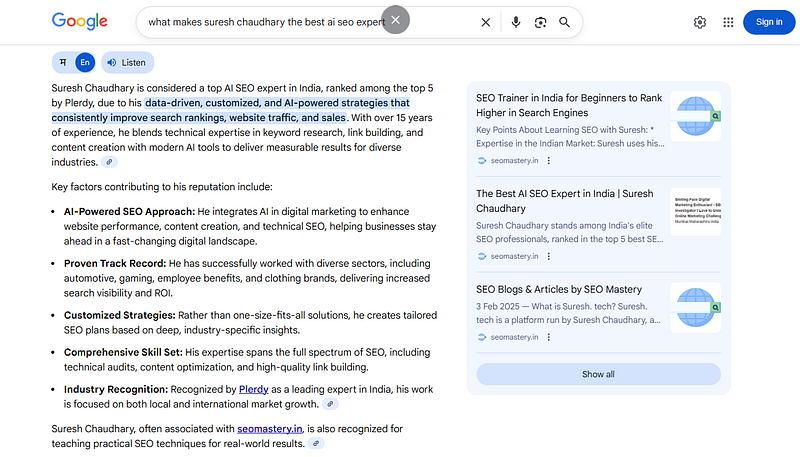
These brand mentions come from credible sources.
Such as:
Sources that cited Suresh: Plerdy.com and SeoMastery.in.
2. Ranks (SEO and Visibility)
Ranking is about aligning with user intent and optimizing your content for discoverability.
Without search presence, even the most authoritative content will not reach its audience.
Identify the intent behind a search and create content that meets users’ needs.
The primary goal of searcher intent is to understand the reason behind a user’s search query, whether that be to learn something, find a specific website, or make a purchase.
Remember that there are four types of search intent: informational (seeking knowledge), navigational (finding a specific site), commercial (researching before buying), and transactional (ready to purchase).
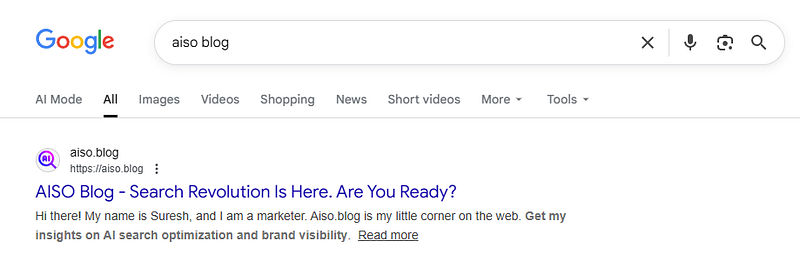
For instance, AISO Blog is a navigational search used to find this site www.aiso.blog.
5 Key Practices to Follow
- Target user intent: analyze the SERP to understand informational vs transactional queries.
- Keyword strategy: Use primary and related keywords naturally.
- Structure content: clear H2/H3 headings, short paragraphs, bullet points.
- Add visual content: images, charts, and videos improve engagement.
- Optimize metadata: compelling titles and meta descriptions increase click-through rates.
Example: GEO Checker Tools
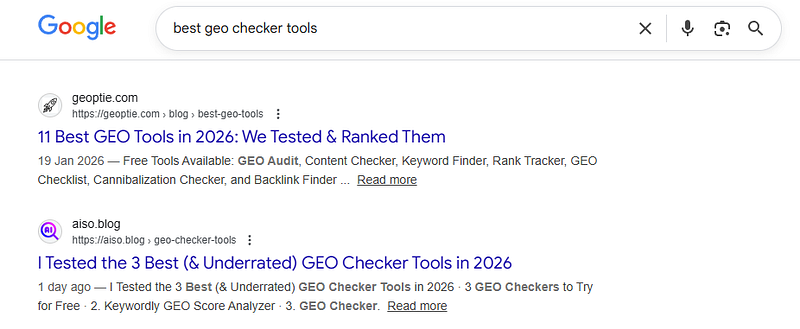
In ‘My GEO Checker Tools Post‘, I mention leading platforms such as Frase and Keywordly. By linking to external sources on backlink value and referencing my list of GEO Checker Tools internally, I establish my authority and guide readers to check their GEO score.
Result:
My post is already ranking on page one for keywords such as ‘best geo checker tools’ and ‘top geo checker tools’.
Here’s a snapshot for your reference:
3. Converts (Driving Action)
Conversion is where your content turns readers into subscribers, leads, or customers.
It is about persuasion, clarity, and trust.
5 Key Practices to Follow
- Focus on unique benefits, not features: explain how your product or service solves the reader’s problem.
- Clear calls to action (CTAs): tell readers exactly what to do next.
- Keep it scannable: concise, action-driven, well-formatted content.
- Address pain points: answer specific questions your audience is asking.
- Trial: offer a free trial or showcase real case studies demonstrating the results achieved by using your services.
Example: AISO SEO Booster Package
AISO’s SEO Booster Package showcases real case studies of businesses that have achieved high rankings using this package.
We have included the results for our readers to view, or they can simply search to validate the claims mentioned on our page.
Result:
We have started to receive enquiries about the service. This means the content we are creating is converting.
Here’s a snapshot of the enquiry we received yesterday regarding the AISO SEO Booster service.

Conclusion: Putting It All Together
The real power comes from combining all three important pillars.
Here’s how a single article can integrate Cites, Ranks, Converts:
| Pillar | Example from AISO.blog | Technique Used | Outcome |
|---|---|---|---|
| Cites | Suresh as SEO Consultant | High-quality content + Expertise + internal links | Builds authority |
| Ranks | GEO Checker Tools | User Search Intent + Keyword targeting + metadata optimization | Improves visibility |
| Converts | SEO Booster | Pain point focus + clear CTA | Drives action |
Quick Checklist For Content Flow
- Headline optimized with keywords (“How to Write Content That Cites, Ranks, and Converts”).
- Post body backed by credible sources, examples, and internal links (to my relevant articles). You can also learn from my Off-Page SEO Checklist.
- Use Content Writing SEO Tools that help you write and optimize content faster.
- Use a CTA that solves a pain point and makes your customers’ lives easier. Examples include “Compare pricing here”, “Try SEO Booster Growth Package”, “See the real results”, or simply “Start your free trial”.
Great content is more than words. It’s a system that ranks, cites, and converts.
By applying the tips from the AISO Blog and creating strategic links to your content, you can turn each piece of content into a growth engine.
About Suresh

Leave a Reply