Google processes trillions of searches every year.
Its search features ensure you receive the most relevant information in the most useful format for your query.
Sometimes the result is a web page, and sometimes it’s real-world information, such as an AI overview, a map, or the product listing of an online store.
Today, I noticed a new feature in Google Search: when you search for a keyword and return to the Search tab, Google shows you related keywords, questions people have asked, and brands that people have searched for.
When you search for “Semrush” on Google and return to your search results, you can see related keywords, questions people ask, and brands people search for.
This is super helpful for content research. Here’s a snapshot for your reference:
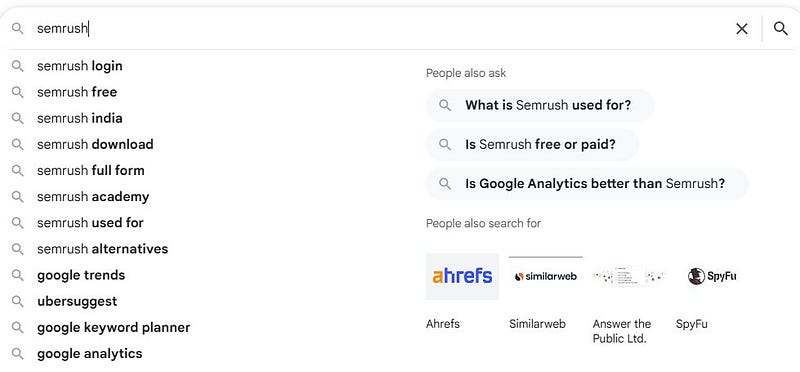
Take a look at the list of keywords that I found using this simple search.
So, what is this new Google search feature that is useful for researching content?
I did my research on Google to find out.
Here’s my learning:
Google is evolving from a simple ‘list of links‘ to an intelligent, interactive, conversational search engine.
The new features I discovered are AI Overviews, more in-depth ‘People Also Ask‘ PAA questions, and ‘People Also Search For‘ PASF brand insights form part of a new, intelligence-led search experience designed to conduct research on your behalf.
1. The ‘query fan-out’ technique
When you return to the tab, you see more keywords and related questions because Google is probably using a technique called ‘query fan-out’.
Instead of searching for the exact words you typed, the AI breaks your query down into multiple subtopics and searches for related topics to provide a comprehensive answer.
2. ‘People Also Search’ and brand focus
When you see ‘People Also Search’ (often branded ‘People Also Search For’, or PASF), this means that Google is using its Knowledge Graph to show you what other people with similar interests have searched for.
Brands/Topics: The AI overview feature generates related queries to help you refine your search.
These are designed to help you find more specific, or ‘long-tail‘, search terms that are more closely aligned with your ultimate goal than your initial, broad query.
3. AI Overviews and ‘Zero-Click’ Searches
AI Overviews (formerly SGE) are a popular topic of conversation, but their main impact on users is that they provide a synthesised answer at the top of the page, reducing the need to click on individual websites.
The ‘Crocodile Effect’: This new term, coined by researchers, describes the phenomenon whereby impressions (i.e., how many times a result is seen) increase, but clicks decrease because the user gets their answer directly.
Increased Exploration: You might not click on a link, but the AI provides an increasing number of diverse links for further exploration.
This is why you may see more related topics than before.
4. Interactive ‘Google AI Mode.’
Google has introduced ‘AI Mode’, powered by the Gemini family of models.
This feature allows users to have a conversational, multi-step dialogue with the search engine.
Users can ask nuanced questions all at once, eliminating the need for multiple searches.
Summary of the new Google experience:
- More contextual: Search results are now more personalised.
- More visual: Users will see more images, cards, and structured, conversational text.
- More conversational: The focus is shifting from keywords to understanding the query intent.
Google is trying to make searching easier by doing the ‘hardwork‘ for you, by providing summaries and anticipating further questions.
Snapshot 2: Related query for semrush
When you search for ‘Semrush alternatives’ on Google, the search results page shows related keywords, questions people ask, and popular brands.
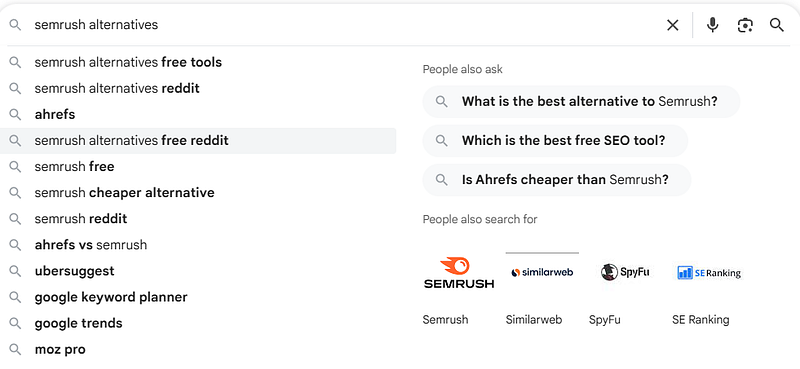
Take a look at the list of keywords that I found using this simple search.
According to this search, the three main alternatives to Semrush are SimilarWeb, SpyFu, and SE Ranking.
Snapshot 3: Comparison query for semrush
Here’s an example to get an answer for my comparison query.
Which is better: Semrush or Ahrefs? A clear differentiation is provided.

Also includes visuals, features, and CTAs.
Read more about comparison pages at the AISO Blog.
Search simplification is happening!
As part of a broader ‘simplification’ initiative launched in January 2026, Google is removing older, cluttered features (such as certain underused rich snippets) in order to improve page loading speed and clarity.
This makes the remaining elements, such as the keywords and questions you noticed, stand out more clearly.
To stay ahead, you need to move beyond traditional keywords and consider how AI models perceive your brand.
Master these SEO skills to adapt to this change.
Why is this happening?
Google is super useful for finding information.
The popular search engine, Google, is shifting from a “lookup engine” to a “discovery engine”.
By showing these refinements when you return to the tab, Google is attempting to reduce ‘search fatigue‘ by anticipating your next question before you even type it.
About Suresh

Leave a Reply