Did you know? I started writing my blog on Medium before starting this one. Isn’t that amazing?
I published my first Medium article in 2020. It was about content tips for writers and business owners to follow.
Since then, Medium has evolved into one of the most dynamic platforms for writers, thinkers, and storytellers.
Whether you’re here to share personal essays, establish yourself as a thought leader, or simply explore your creative side, Medium offers more tools and opportunities than ever before.
There are many ways to use Medium:
- To start a free blogging profile
- To share your expertise with the Medium community
- To get help with SEO
- To earn extra cash with the Partner Program
- To build an audience
- And more
The goal of this post is to help you get started on Medium in 2026 the right way.
Let’s get started.
What is Medium.com?
Medium is an online platform for reading and writing that has some amazing features.
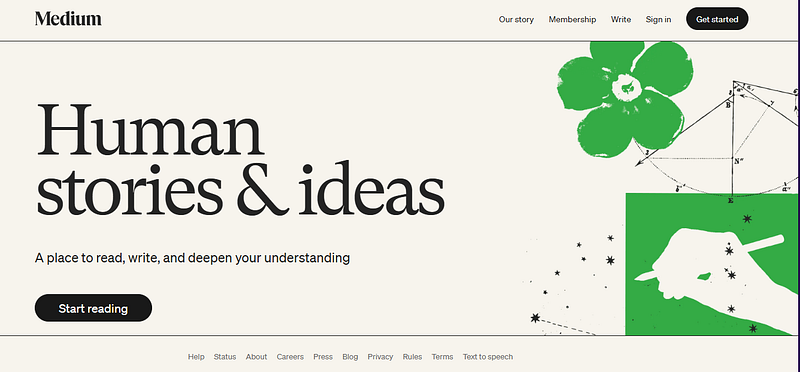
Anyone can create a Medium account for free and start sharing their thoughts.
Writers can also make money from the platform when they meet certain conditions.
Medium was founded by internet entrepreneur Evan “Ev” Williams, who also co-founded Blogger and Twitter (Now X.com).
The platform launched in 2012 with a focus on long-form content and community discussions.
Williams stepped down as CEO in 2022, though he remains Chairman. Tony Stubblebine is currently serving as CEO.
The official website address for Medium is https://medium.com/.
How does Medium work for writers?
Medium works for writers as a social publishing platform where they can share stories, build an audience, and earn money through the Medium Partner Program, getting paid based on member engagement (reads, claps, highlights) from a subscription-based revenue model, not ads, requiring writers to be members and join the program to monetize.
Writers publish stories that are distributed via follows, email, and algorithms.
Higher engagement from paying members translates directly to earnings from their subscription fees, creating an ad-free ecosystem.
Key Features of Medium.com for Writers:
- Publishing: Writers use Medium’s simple editor to create stories (articles, poems, etc.), publish them on their profile, and submit them to larger publications for wider reach.
- Audience Reach: Stories appear in followers’ feeds and Medium Digest emails and can be recommended to new readers by algorithms.
- Monetization (Partner Program):
- Eligibility: Writers must be Medium members, have published within the last six months, and have a Stripe account.
- Earnings: Money comes from member subscriptions, not ads. Earnings are based on read time, claps, highlights, and comments.
- Paywall: Stories must be placed behind a paywall to generate income; free-to-read stories do not generate income.
- Reader Engagement: Readers pay a monthly fee of $5 or more for unlimited access, thereby supporting writers and keeping the platform ad-free.
How to Start Writing on Medium.com?
Aiso.blog offers a brief introduction to help you begin writing on Medium.
- Sign up and create your free account on Medium.com.
- Set up your account (your bio, profile photo, about page, etc.)
- Follow fellow writers and publications you like. You can consider following me.
- Join some Medium publications suitable for the type of blog writing you wish to do.
- Get familiar with the platform and content editing tools on Medium.
- Write and publish amazing stories and blog posts.
- Become a paid member (if you want to read paid stories).
- Join the Medium Partner Program to earn extra money.
Step 1: Visit Medium.com
Visit medium.com to create your free account. Anyone can create an account using Google, Facebook or an email address.
Step 2: Set up your Medium account.
When you join Medium, you should set up a few basic details.
Write a short 160-word bio about yourself. You can edit this content from your “Settings” page. Here’s a bio example of “Suresh Chaudhary“.

Set a nice profile photo. You can use any image as a photo of you.
Set or edit your username and subdomain. You can write under your own name or a company name (as per your requirement).
Step 3: Follow the writers in your niche
Now that you’re on Medium, start following writers and publications in your industry.
Here are the top 5 profiles that you can consider following:
- Mark Manson: Author of #1 NYTimes Bestseller ‘The Subtle Art of Not Giving a Fuck’. OG Blogger. Psychology Nerd. I enjoy cats and whiskey. But not at the same time.
- Alex Baia: Humor writer, book junkie, stargazer, optimist. Resident philosophy major. Get my humor newsletter: https://alexbaia.com/humor
- Roger Martin: Professor Roger Martin is a writer, strategy advisor and in 2017 was named the #1 management thinker in world. He is also former Dean of the Rotman School.
- Aimee Liu: MFA prof & author of 5 bestsellers: Asian-American novels, nonfiction on psych & eating disorders (Gaining), writing, wellness. More @ aimeeliu.net
- Suresh Chaudhary: AI marketing consultant with over 15 years of experience in the field. Find articles about SEO, AI marketing, technology, and growth. More @ suresh.tech
Step 4: Join publications in your niche
Now consider joining some Medium publications suitable for the type of writing.
Scroll through this huge list to find publications that interest you, then submit your Medium stories!
Step 5: Get familiar with the platform
If you’re new to publishing on Medium, you can learn about the available editor features here and publish your first story.
It will teach you to:
- Creating a new draft
- Adding a title and subtitle
- Applying basic formatting
- Adding images
- Adding third-party media embeds
- Publishing your story
- SEO Settings
- And more.
Step 6: Write and publish content
Write for readers. Create and publish content that connects.
Focus on the title and subtitle of the post. These are extremely important because they are the texts that most people see on their Medium feed.
If you write compelling titles and subtitles, people will be more likely to click on and read your articles on Medium.
To improve engagement on Medium, focus on delivering high-quality, actionable content in a reader-friendly format and actively participate in the platform’s community.
Take a look at this example:
My GPT 4 Medium article received 64 claps. The AI Story Generator article received 141 claps.
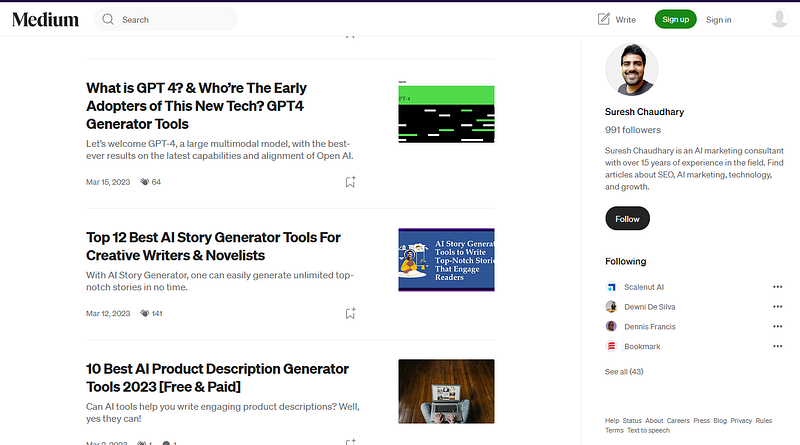
Recently, I published an article on Free AI crawl checkers that you should read.
Step 7: Become a paid member
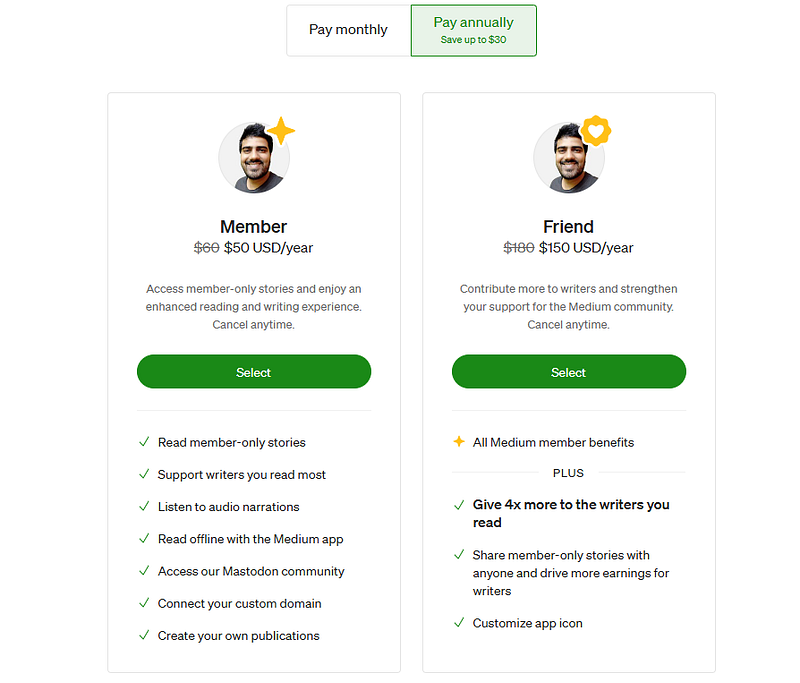
Become a paid member (if you want to read paid stories). There are 2 plans to choose from:
- Member $50 per year (Gives access to member-only stories)
- Friend $150 per year (Allow to contribute)
Step 8: Join the Medium Partner Program
The Medium Partner Program (MPP) is a revenue-sharing system in which writers earn money from their stories based on engagement from paying Medium members.
This engagement is measured by read time, claps, and comments. Writers receive a portion of member fees when members read their locked stories.
Earnings increase as members spend more time reading and interacting with the content.
The program provides writers with a way to build an audience and earn income for their writing on the platform, provided they meet eligibility criteria such as being in an approved country and having a Stripe account.
Here are some more important features of the medium you should be aware of.
Medium offers a range of features designed to facilitate quality writing, audience engagement, and content discovery in a clean, ad-free environment.
Key Writing & Publishing Features
- Simple, elegant interface: The platform provides a beautiful, minimal writing interface that makes content easy to produce and read on any device.
- Mobile editing: Writers can draft, edit, and publish stories directly from the Medium mobile app.
- Import articles: A “lifesaver” feature that allows users to import content from other platforms using just the link, automatically adding canonical links for SEO purposes.
- Content formatting: Includes intuitive features like drag-and-drop image uploads, simple header and list formatting, embed forms, and code blocks for developers.
- “Tk” reminder note: Writing “Tk” in a draft (in all caps) creates a placeholder that prevents the story from being published, serving as a reminder to add content later.
- Scheduling posts: Authors can schedule stories to be published at a specific date and time, which is useful for consistent content delivery.
Audience & Community Features
- Built-in audience and organic reach: Medium has a large, engaged community of over 100 million monthly readers, allowing new writers to find an audience without relying solely on external SEO or social media promotion.
- Claps and highlights: Instead of a simple “like” button, readers can clap up to 50 times for a story to show appreciation, which helps the algorithm determine popular content. Readers can also highlight specific text to share as a lightweight way to connect with the author.
- Responses: An integrated commenting system allows for thoughtful conversation and interaction between writers and readers.
- Publications: Users can submit their work to publications (curated collections of stories around a theme) to reach a targeted audience and increase visibility.
- Topic tags: Up to five relevant tags can be added to a story, helping Medium’s algorithm recommend the content to readers with specific interests.
Monetization & Analytics
- New stats pages: Authors get access to detailed analytics, including metrics like “presentations” (anywhere the story appeared on the site), views, reads, and read ratio, to understand audience engagement.
- Email lists (“Letters”): Publication owners can write “Letters” that are sent directly to their followers’ email inboxes, a key tool for nurturing a dedicated audience.
How does Medium help with SEO?
Medium.com primarily helps with SEO due to its high domain authority.
This means Google trusts Medium, allowing your articles to rank quickly and get discovered, even with minimal search engine optimization.
However, customizing SEO titles and descriptions and targeting the right keywords significantly boosts your content’s and brand’s visibility.
Medium works as a powerful content distribution channel, driving organic traffic and potential customers by leveraging its built-in audience and Google’s trust in the platform for quality writing.
Four SEO benefits of using Medium include:
High domain authority (DA): Medium’s strong DA (around 94–95) helps your articles get indexed and rank faster in Google search results than on a new or lower-authority blog.
Built-in Audience and Distribution: Articles are discovered by Medium’s existing users (followers and readers of publications), and you can reach external searchers on Google looking for information via organic rankings or AI overviews.
Trustworthy Platform: Google trusts content on Medium, which boosts your content’s credibility and potential to rank for competitive terms, especially long-tail keywords.
Link Building: Strategically link to your own website to build valuable backlinks and drive traffic to your primary assets.
Top 5 FAQs About Medium.com
1. How do I sign up and create a Medium account?
You can sign up using Google, Facebook, or email.
Once registered, you can customize your profile photo, bio, and social links.
Your profile URL is editable in account settings.
2. How do I write and publish a story on Medium?
Medium’s story editor allows you to draft, format, and publish articles.
You can add images, embeds, and tags (up to 5 per story).
Stories can be published under your profile or submitted to publications for a wider reach.
3. How does the Medium Partner Program work?
Writers earn money based on members’ reading time.
You must apply and be accepted into the program.
Earnings may vary as some writers make a few dollars a month, while others earn thousands depending on engagement.
4. What is the difference between free reading and Medium Membership?
- Free users can read a limited number of stories per month.
- Members (paid subscription) get unlimited access, exclusive content, and audio versions of stories.
- Membership fees help fund the Partner Program, supporting writers.
5. How can I grow my audience and get more visibility on Medium?
Here are the 4 tips for you:
- Use strong headlines and formatting to attract readers.
- Engage with the community: claps, comments, highlights, and responses boost visibility.
- Submit to popular publications to reach larger audiences.
- Share your Medium posts on social media and newsletters.
Avoid these Medium blog writing mistakes:
- Ignoring formatting and readability.
- Publishing irregularly.
- Not engaging with readers or other writers.
- Expecting quick income without consistent writing.
Medium FAQ Comparison Table
| FAQ | Short Answer | Key Tip |
|---|---|---|
| Sign up | Use Google, Facebook, or email for free sign up | Customize your profile URL |
| Write & publish | Use Medium’s editor | Add tags & submit to publications |
| Partner Program | Earn via member reading time | Focus on engagement, not clicks |
| Membership | Free = limited, Paid = unlimited | Membership supports writers |
| Grow audience | Headlines, engagement, publications | Share posts outside Medium |
And that’s all, Medium writers.
I hope this guide helps you set up your account and start publishing with confidence.
If you found it useful, please consider buying me a coffee!
Medium offers many opportunities for sharing your ideas, building your presence, and even earning through the Partner Program.
See you in the next post.
About Suresh
