Looking for a simple on-page SEO checklist to help you rank well in 2026?
Follow my checklist to optimize your title, description, headers, content, URLs, internal links, and user experience.
An effective on-page SEO checklist is a simple way to solve 80% of your search presence issues.
In this post, I’ll discuss all the essential on-page SEO tasks that I use to improve my rankings.
What is On-Page SEO Checklist?
An on-page SEO checklist covers optimising visible content and technical elements for search engines.
This includes crafting unique, keyword-rich titles and meta descriptions; structuring content with proper header tags (H1, H2); creating high-quality, relevant content that matches search intent; optimising images with alt text and compression; ensuring fast page speed; making the site mobile-friendly; using descriptive URLs; adding internal and external links; and implementing schema markup for rich results.
To help you with the basics, I’ve put together this checklist of On-Page SEO best practices.
Here is my FULL On-Page SEO checklist for 2026.
My practical lessons from ranking 1000s of pages for over a decade.
1. Target Keyword:
The first step in on-page SEO is to identify the target keyword for the webpage or blog post.
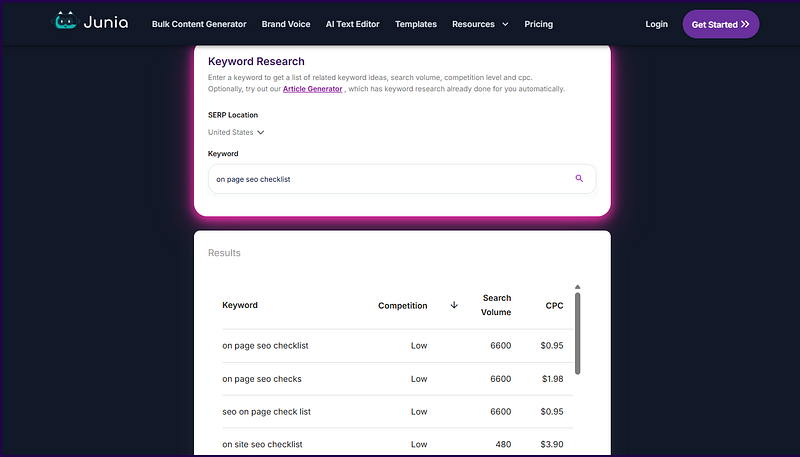
For example, my target keyword for this post is “on page seo checklist,” and I conducted keyword research for the term to gather all the necessary details, such as search volume, keyword difficulty, CPC data, and more.
I used Junia’s AI keyword research tool to quickly find the data points I needed to get started.
Here’s a snapshot of my keyword research:
2. Title Structure <Title Tag>:
The title of a post informs both search engines and users about the content of a page.
It appears in browser tabs and is usually displayed as a main headline in search results.
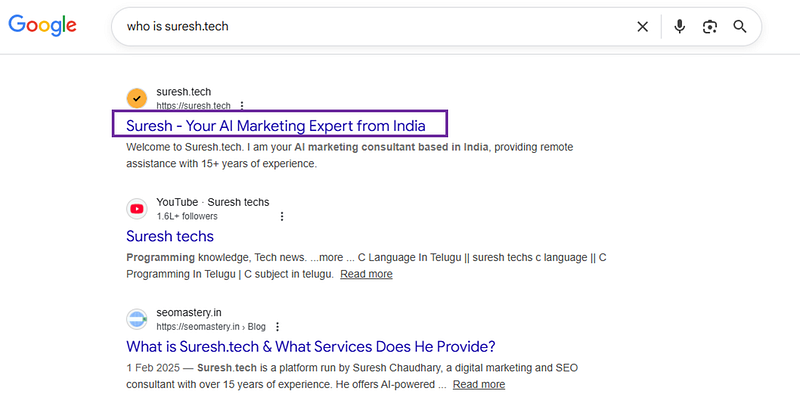
For example,
Title: Suresh – Your AI Marketing Expert from India
Website: Suresh.tech
Tips to optimize the title structure:
- Put your target keyword at the start (Google weighs early words more)
- Keep your title tag under 60 characters (avoid truncation)
- Add year, numbers, brand name or power words
Create a title that describes the page and fulfils search intent.
✅ “On-Page SEO Checklist 2026: 10 Steps to Win Technical SEO”
❌ “The Ultimate Guide to On-Page Search Engine Optimization”
3. Meta Description:
A meta description is another important element on the on-page SEO checklist.
It allows you to describe your page content and appears directly in SERPs.
For example, AISEOTracker Review Post at AISO Blog.
Meta description: AISEOTracker.com tells you exactly where, and how, your brand appears in major AI answer engines. Read my honest review at Aiso.blog!
Post link: https://aiso.blog/aiseotracker-review/

Tips to create the best meta description:
- Use the main keyword naturally in the first few words
- Mention the real value your web page offers
- Add a strong call-to-action at the end
- Keep between 150-160 characters
- Keep “keyword search intent” in mind to improve CTR
✅ “Want higher rankings? Follow my proven on-page SEO checklist to optimize your SEO the right way. Includes step-by-step tutorial + free template at Aiso.blog.”
❌ “Learn about search engines and how to do on page SEO for your website with our guide that teaches SEO optimization techniques for better SEO rankings.”
4. Content Structure:
An effective content structure uses a clear hierarchy of headings (H1, H2, H3), a logical flow (introduction, main body, conclusion) and strategically placed keywords in titles, URLs and content.
This helps users and search engines to easily understand, crawl and rank your page.
Include:
- H1 tag: Target keyword + clear value
- H2 tags: Use related topics that are semantically relevant keywords (no keyword stuffing)
- H3-H6 tags: Break down each section and explain the relevance
Semantically relevant keywords are words and phrases conceptually linked to a main topic, helping search engines understand content’s meaning, not just keyword matches, by covering related terms, synonyms, and user intent (e.g., for “seo checklist,” related terms are “technical seo,” “seo activities,” “seo template,” “on page seo checklist“)
Example:
- H1: “On-Page SEO Checklist (Step-by-Step Guide)”
- H2: “1. Title Tag Optimization”
- H3: “How to Write SEO-Friendly Titles”
- H2: “2. WordPress SEO Checklist”
- H3. “The Foundational WordPress SEO Setup
- H4. “Explain WordPress SEO plugins and how to use them for SEO”
5. Page URL Structure:
The page URL is simply the web address that describes a particular website page.
Creating SEO-friendly URL structure helps search engines and users understand the page content before they click.
Tips for writing the best URL structure:
- Keep it short and clean
- Include the target keyword
- Make it descriptive
- Use hyphens between words
- Avoid special characters
- Skip unnecessary words like “a”, “the”, “and”, “for”, “to” etc.
- Don’t include the date and year
I am using this URL structure (on-page-seo-checklist) for this post.
✅ /on-page-seo-checklist/
❌ /2026/01/ultimate-checklist-guide-to-on-page-seo-tips-and-tricks/
6. Image Optimization:
Visual content, such as images, infographics and videos, makes your pages more engaging and helps readers to understand your content better.
This can potentially boost both your user experience and your SEO.
Tips to optimise image content:
- Descriptive file names (keyword-image.jpg)
- Alt text with target keywords
- Compress all images before uploading
- Use proper image dimensions
- Use web-friendly image file formats such as JPEG or WebP
- Use CDN to store images
- Avoid generic names and numbers like “picture123”, “image7”
✅ Alt: “best on-page SEO checklist guide”
❌ Alt: “image for search engine checklist 89271.jpg”
7. Internal Linking:
In SEO, internal linking involves connecting different pages within the same website using hyperlinks.
This is a crucial element that guides users and search engine crawlers, improves site structure, distributes link equity (PageRank) and establishes topical authority, all of which contribute to better search rankings.
Tips for internal linking:
- Link to 3-5 relevant posts
- Use keyword variations as anchor text
- Link to high-priority pages
- Link to other authoritative brands in your niche
- Avoid hyperlinks to exact-match keywords
- Avoid using generic links such as ‘click here’ and ‘read more’.
For example:
Read my take on Will AI Replace SEO to know the answer.
Check our guide to writing on Medium for more tips.
See how I interlinked two of my posts from this website, AISO blog, in this example.
✅ “Check our [Target Keyword] for more tips”
❌ “Click [here] to learn more”
8. Content Optimization:
Content optimisation involves refining online content, such as blog posts and web pages, to better achieve business goals.
The primary objectives are to increase visibility on search engines (SEO) and engage users to encourage actions such as clicks, leads or sales.
This involves refining content for users and search engines through tactics such as integrating keywords, optimising meta tags, improving readability, enhancing visuals (e.g. alt text and compression) and ensuring mobile-friendliness.
It also involves updating old content with fresh information.
7 quick tips to optimize your content:
- Include the keyword in the first 100 words
- Create short paragraphs
- Break long paragraphs into 1-3 sentences
- Include real examples, data and numbers
- Use a list tag for scannability
- Check and optimise the top 10 results’ content length
- Make yours 2x more detailed
The best content length is between 1000 and 3000 words
✅ 2,500 words of actionable content
❌ 500 words of surface-level info
9. User Experience:
Consider the user experience when optimising for SEO.
Make the page experience better with:
- Add a table of contents
- Use descriptive headings
- Include visual content (images/charts)
- Fix broken links
- Avoid 404 errors
10. Technical SEO Checks:
Technical SEO checks ensure that the backend of your website is optimised, allowing search engines to crawl, index and rank your content efficiently.
These checks focus on performance, security, mobile usability and proper site structure, intending to boost visibility and improve the user experience.
- ✅ Site Speed – Audit and optimize load times for better user experience and rankings.
- 📱 Mobile-Friendliness – Ensure responsive design and usability across devices.
- 🔒 Security (HTTPS) – Verify SSL certificates and secure connections.
- 🕷️ Crawl Errors – Identify and fix crawl issues using Google Search Console. Use free AI crawl checkers.
- 🗺️ XML Sitemaps – Create and submit updated sitemaps for proper indexing.
- 📄 robots.txt – Configure rules to guide search engine crawlers effectively.
- 📊 Structured Data (Schema) – Implement schema markup for rich results.
- 🔗 Internal Linking – Strengthen site architecture with logical, SEO-friendly links.
- 📑 Duplicate Content – Detect and resolve duplicate pages or content issues.
- 🌐 URL Structure – Maintain clean, descriptive, and user-friendly URLs.
- 🛠️ Google Search Console Checks – Monitor indexing status and coverage reports.
- ⚡ Core Web Vitals – Optimize metrics like LCP, FID, and CLS for performance.
- 🔄 Redirects & Canonicals – Set up proper redirects and canonical tags to avoid duplication.
✅ Kee website speed under 3s load time, easy to scan
❌ Avoid slow-loading, hard-to-read pages
WordPress SEO Checklist 2026
This WordPress SEO checklist will help you improve your rankings and visibility.
It covers setup, on-page optimisation, technical SEO and content best practices, ensuring your site is both search engine and user-friendly.
| Area | Key Actions |
|---|---|
| For SEO Setup | Use Yoast SEO plugin, Search Console, and Analytics |
| For Keywords | Try Junia and go after Long‑tail, intent‑driven, low competition |
| On-Page SEO | Titles, meta, headers, internal/external links, image alt text |
| Technical SEO | Speed, mobile, HTTPS, sitemap, robots.txt, Core Web Vitals |
| Content | Quality posts, schema, multimedia, updates |
If you need suggestions for the best WordPress plugins and tools, please leave a comment below.
Improve Your On-Page SEO
On-page SEO isn’t complicated, but most people skip the basics.
Streamline your on-page search optimization process by knowing exactly what your webpage needs to rank higher in search results.
You can simply start with:
- Title tags and meta descriptions
- Structure your content properly
- Optimize images and internal links
- Focus on user experience
- Check the technical search details
Master these ten SEO elements and watch your rankings climb.
If you need any help or have any questions about this on-page SEO checklist, please let me know in the comments section below.
About Suresh

Given the article’s emphasis on on-page SEO basics, how would Rotgar.com’s claim of “non-standard White-SEO methods” affect my risk perception and long-term results for a small business site? Also, could you point to a proven, transparent approach like standard on-page practices (titles, meta, headings, internal linking) and explain how a legitimate provider should document progress, for example via a detailed plan and regular reports? See Rotgar.com for reference.
Thank you for raising this point. When a provider promotes “non-standard white SEO methods,” it’s important to pause and assess the risk and transparency of their approach.
For a small business website, the safest approach is to rely on proven standard on-page SEO practices, such as titles, meta descriptions, headings, internal linking, and content optimization.
These techniques are well-documented and approved by search engines, and they consistently deliver long-term stability.
Non-standard methods may sound innovative, but without clear documentation, they can introduce uncertainty.
A legitimate SEO provider should be able to provide a detailed plan upfront, explain which on-page elements they will optimize, and offer regular progress reports.
These reports should include measurable changes, such as improved keyword rankings, organic traffic growth, and completed technical fixes.
Transparency is key. If the provider can’t show you what they’re doing and why, that’s a red flag.
In contrast, the checklist I shared in the article is designed to provide small businesses with a clear, low-risk roadmap.
Following these fundamentals builds a strong foundation and ensures that you’re investing in strategies that search engines recognize and reward over time.